
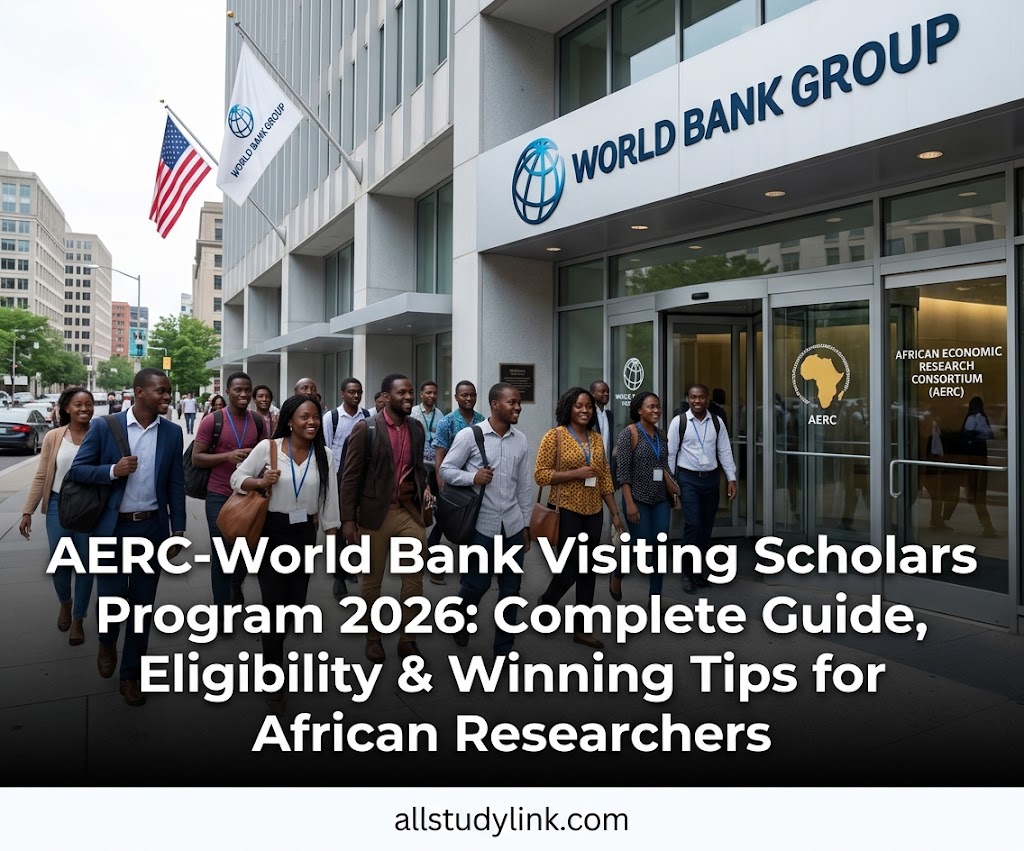
Apply for the AERC-World Bank Visiting Scholars Program 2026. Explore eligibility, benefits, application steps, and expert tips for African researchers.
Sub-Saharan Africa stands at a critical historical juncture, requiring robust economic policies to drive sustainable development, poverty reduction, and structural transformation. Consequently, building institutional capacity and empowering African scholars to lead this change remains paramount.
To bridge the gap between academic research and global development policy, two premier institutions joined hands: the African Economic Research Consortium (AERC) https://aercafrica.org/ and The World Bank Group https://www.worldbank.org/ext/en/home
Through this powerful partnership, the AERC-World Bank Visiting Scholars Program 2026 offers African researchers a transformative, fully funded fellowship at the World Bank Headquarters in Washington, D.C. Furthermore, this initiative provides an ideal platform for economists to collaborate with world-class experts, refine critical policy papers, and shape development strategies across the continent.
Whether you are an established African researcher, an academic in Nigeria, or a development enthusiast following global scholarship trends, this comprehensive guide provides every detail you need to understand, prepare for, and win this prestigious award.
Detailed Background of the AERC-World Bank Visiting Scholars Program
The African Economic Research Consortium (AERC), established in 1988, is a premier Pan-African research and capacity-building organization. AERC strives to strengthen local capacity for conducting independent, rigorous research into problems pertinent to the management of economies in Sub-Saharan Africa. Meanwhile, the Office of the Chief Economist for the Africa Region (DECAF) at the World Bank leads high-level analytical work, regional flagship studies, and policy advisory services across the continent.
To foster closer institutional collaboration, AERC and the World Bank created the visiting research initiative. Therefore, the AERC-World Bank Visiting Scholars Program 2026 was designed to give selected African scholars direct exposure to international policy formulation.
During a residential tenure lasting 4 to 6 months in Washington, D.C., scholars work directly alongside World Bank economists. Furthermore, participants engage in capacity-building sessions, contribute to ongoing African regional flagship studies, present seminars, and revise draft papers for publication in top-tier international journals. As a result, the fellowship transforms academic researchers into influential policy architects whose work directly impacts lives across Sub-Saharan Africa.
Why the AERC-World Bank Visiting Scholars Program 2026 Matters for Africa and Nigeria
The economic development landscape in Africa requires localized, empirical solutions tailored to complex socioeconomic realities. Therefore, the AERC-World Bank Visiting Scholars Program holds immense value for scholars across the continent, particularly in Nigeria.
Global Perspective with Local African Impact
First, the global financial architecture often drafts general development templates. However, through this fellowship, African researchers bring real-world, ground-level insights into global policy discussions. Consequently, visiting scholars ensure that World Bank regional strategies address the unique structural realities of African economies.
Strategic Relevance for Nigerian Scholars
Nigeria, as Sub-Saharan Africa’s largest economy, faces significant macroeconomic adjustments, currency dynamics, energy transition choices, and youth employment challenges.
Consequently, Nigerian researchers participating in the AERC-World Bank Visiting Scholars Program gain access to cutting-edge analytical tools, massive institutional datasets, and global economic models. As a result, when these scholars return to Nigerian universities and policy think-tanks, they elevate domestic academic standards and contribute directly to national economic governance.
Comprehensive Eligibility Criteria for the AERC-World Bank Visiting Scholars Program 2026
Because the fellowship is highly competitive—selecting up to two scholars per cohort—meeting every eligibility criterion is vital. Therefore, candidates must carefully review the required qualifications before preparing their application packages.
AERC Network Membership: Applicants must be active researchers within the AERC network, including faculty members and researchers affiliated with the AERC Collaborative PhD Programme (CPP).
Active Research Paper Status: Candidates must possess an active AERC research project that has reached at least the interim/post-field stage or the final research paper stage.
Alignment with World Bank Priorities: The candidate’s research proposal must align directly with the key policy priorities of the World Bank Africa Region Chief Economist’s Office.
Institutional Endorsement: Applicants attached to academic or research institutions must demonstrate support from their home organizations to undertake a 4 to 6-month residence in Washington, D.C.
Inclusivity Considerations: AERC and the World Bank actively encourage applications from female researchers, as well as Francophone and Lusophone African candidates, to ensure geographic and gender balance.
Key Benefits and Fellowship Coverage
Participants in the AERC-World Bank Visiting Scholars Program receive full institutional support during their tenure. While specific award letters outline precise financial arrangements, key benefits include:
World Bank Headquarters Residency: Full access to state-of-the-art research facilities, databases, and libraries at the World Bank in Washington, D.C.
Direct Professional Mentorship: Collaboration with senior economists and policy specialists within the Office of the Chief Economist for Africa (DECAF).
Journal Publication Support: Dedicated time and expert feedback to refine draft papers for submission to high-impact, peer-reviewed journals and the World Bank Working Paper Series.
Global Networking: Opportunities to present research seminars, attend high-level international conferences, and build long-term research networks.
Fully Funded Fellowship: Coverage for travel, accommodation, living stipends, and administrative support as per World Bank consultancy policies.
Strategic Tips to Win the AERC-World Bank Visiting Scholars Program 2026
Because only a few candidates are selected for each cohort, submitting a basic application is not enough. Instead, candidates must position their work strategically. Below are well-researched, actionable tips to make your application stand out.
1. Align Your Draft Paper with Regional Flagship Themes
First, study the recent flagship reports published by the World Bank Africa Region Chief Economist’s Office. Aligning your ongoing AERC research paper with current priorities—such as digital transformation, climate resilience, debt sustainability, or job creation—makes your application immediately relevant to reviewers.
2. Craft a Compelling Two-Page Statement of Interest
Second, your two-page statement must be concise, articulate, and persuasive. Clearly explain why your research matters, what specific methodologies you plan to refine at the World Bank, and how your stay will benefit both your home institution and Africa’s broader development goals.
3. Highlight Methodological Rigor and Data Relevance
Third, ensure that your draft research paper demonstrates strong analytical and econometric methodologies. The selection committee prioritizes papers that combine theoretical sound research with empirical policy solutions.
4. Demonstrate Teaching and Knowledge-Transfer Impact
Fourth, if you teach relevant university courses, submit your curriculum and course materials. Explain how the insights, datasets, and methodologies gained during the fellowship will be integrated into your teaching back home to train the next generation of African economists.
5. Submit Early and Proofread Thoroughly
Finally, avoid last-minute technical errors. Prepare all required attachments—including your updated CV, statement of interest, and draft paper—well before the submission deadline.
Application Process and Step-by-Step Guide
Applying for the fellowship requires sending a complete package via email directly to the AERC Research Department.
Required Application Documents:
- 1. Two-Page Statement of Interest
- 2. Draft Research Paper (Relevant to Africa Region Agenda)
- 3. Curriculum / Course Materials (If currently teaching)
- 4. Updated Curriculum Vitae (CV)
Official Application Details
Submission Email: Send your completed application package to abbi.kedir@aercafrica.org and copy (cc) research@aercafrica.org.
Application Deadline: September 6, 2026.
Official Portals: Visit the AERC Official Website https://aercafrica.org/and The World Bank Careers Portal https://www.worldbank.org/ext/en/careers for program updates and institutional information.
Frequently Asked Questions (FAQS) And Answers About the AERC-World Bank Visiting Scholars Program 2026
What is the primary objective of the AERC-World Bank Visiting Scholars Program 2026?
The primary goal is to strengthen economic research capabilities across Sub-Saharan Africa by offering researchers a 4 to 6-month fellowship at the World Bank in Washington, D.C., where they collaborate on policy-relevant economic development topics.
Who is eligible to apply for the AERC-World Bank Visiting Scholars Program 2026?
Applicants must be active researchers in the AERC network (including Collaborative PhD Programme members) with an ongoing research project at the interim/post-field or final paper stage.
How many scholars are selected for the AERC-World Bank Visiting Scholars Program 2026?
Up to two awards are announced for the 2026/2027 cohort, making the program highly selective.
Are female and non-English speaking researchers encouraged to apply for AERC-World Bank Visiting Scholars Program 2026?
Yes, female candidates, as well as Francophone and Lusophone African researchers, are explicitly encouraged to submit their expressions of interest.
How do candidates submit their application for the AERC-World Bank Visiting Scholars Program 2026?
Interested applicants must email their application package—including a statement of interest, draft research paper, updated CV, and course materials (if applicable)—to abbi.kedir@aercafrica.org and copy research@aercafrica.org before September 6, 2026.
Conclusion: Final Thoughts on the AERC-World Bank Visiting Scholars Program 2026
The AERC-World Bank Visiting Scholars Program 2026 represents an extraordinary opportunity for African economists to elevate their research to a global stage. By bridging academic research in Africa with actionable policy design at the World Bank, this fellowship empowers scholars to drive meaningful economic transformation across the continent.
If you meet the eligibility criteria, start preparing your application early. Refine your draft paper, articulate your vision clearly in your statement of interest, and submit your package before the deadline to take a decisive step forward in your research career.
Good luck with your application.
Was this post helpful to you?
Comment below.