
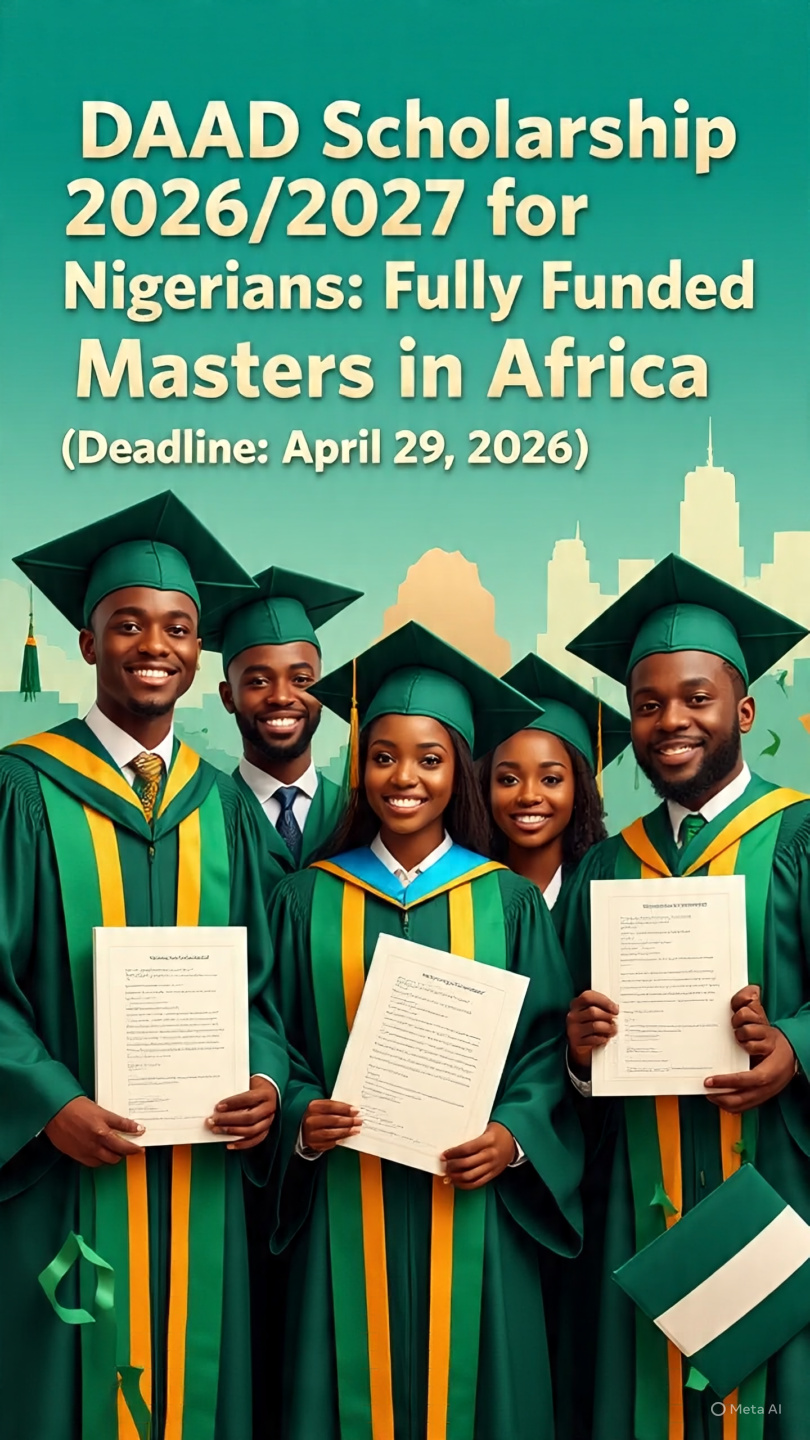
Apply for the DAAD Scholarship 2026/2027 for Nigerians. Fully funded Masters in Africa with tuition, stipend & research funds. Deadline April 29, 2026. See eligible courses & how to apply.
If you are a Nigerian graduate planning a career in teaching, research, or development, the DAAD Scholarship 2026/2027 for Nigerians is one of the most strategic fully funded opportunities you can apply for this year. Unlike scholarships that take you to Europe, the DAAD Scholarship 2026/2027 for Nigerians funds Master’s degrees right here in Africa at carefully selected, high-quality universities. It is sponsored by the German Academic Exchange Service (DAAD) with funding from the German Federal Ministry for Economic Cooperation and Development (BMZ).
The DAAD Scholarship 2026/2027 for Nigerians removes the biggest barriers to postgraduate education: tuition fees, living costs, research expenses, and thesis costs. For Nigerians admitted to approved programmes, this scholarship pays for everything so you can focus on producing research that solves real problems in Nigeria and West Africa. Applications for the DAAD Scholarship 2026/2027 for Nigerians are now open, and the official deadline is April 29, 2026. Because competition is high, understanding the structure, requirements, and selection logic of the DAAD Scholarship 2026/2027 for Nigerians gives you a clear edge.
This guide breaks down everything about the DAAD Scholarship 2026/2027 for Nigerians: history, benefits, approved Nigerian programmes, documents, how to apply, and proven tips to win.
Background of the Scholarship with Statistics of Individuals That Have Benefited from the Scholarship Since Inception.
The DAAD In-Country/In-Region Programme started over 20 years ago to strengthen higher education systems within Sub-Saharan Africa and reduce brain drain. The logic is simple: Africa needs more professors, researchers, and policy experts trained to international standards, but working within African institutions. The DAAD Scholarship 2026/2027 for Nigerians continues that mission.
Since inception, DAAD has awarded more than 3,000 In-Country/In-Region scholarships across Sub-Saharan Africa. Within the wider DAAD Africa portfolio, over 10,000 African scholars have been funded. Impact tracking shows that 86% of DAAD In-Country/In-Region alumni remain working in Africa post-study. About 72% are employed in universities or public research institutions, directly building academic capacity. DAAD alumni networks have produced more than 4,500 peer-reviewed publications and facilitated over 120 institutional partnerships between African and German universities.
For Nigerians specifically, the DAAD Scholarship 2026/2027 for Nigerians builds on a strong track record. Nigerian universities have hosted DAAD scholars for over a decade, producing graduates who now lecture at FUNAAB, University of Ibadan, UNILAG, MOUAU, and other federal institutions. The DAAD Scholarship 2026/2027 for Nigerians is therefore not a new experiment — it is a proven pathway into Nigerian academia and research.
What the Scholarship Is About
The DAAD Scholarship 2026/2027 for Nigerians funds development-related Master’s studies for Nigerians who intend to pursue careers in teaching and/or research at higher education institutions in Sub-Saharan Africa.
There are two tracks under the DAAD Scholarship 2026/2027 for Nigerians:
1. In-Country Scholarships: You study in Nigeria at a DAAD-approved Nigerian university. This is for Nigerians who want to remain in the country during their Master’s.
2. In-Region Scholarships: You study in another Sub-Saharan African country where you are not a citizen or permanent resident. Example: A Nigerian using the DAAD Scholarship 2026/2027 for Nigerians to study in Ghana, Kenya, or South Africa.
All courses supported by the DAAD Scholarship 2026/2027 for Nigerians must align with the UN Sustainable Development Goals. Your research must address challenges like food security, public health, climate adaptation, education quality, governance, or renewable energy. The DAAD Scholarship 2026/2027 for Nigerians is an investment in people who will strengthen Nigerian and African institutions after graduation.
Available Fields of Study
The DAAD Scholarship 2026/2027 for Nigerians only funds specific, pre-approved programmes listed in the annual “Call for Applications – Nigeria”. You cannot just pick any Master’s course. For the 2026/2027 intake, approved programmes for Nigerians include:
University Programme & Track
Federal University of Agriculture Abeokuta (FUNAAB) – MSc in Physics (In-Country).
Rev. Fr. Moses Orshio Adasu University, Makurdi – Master & PhD in Food Chemistry (In-Country).
University of Ghana, WACCI – Master in Seed Science and Technology (In-Region).
University of Ghana, WACCBIP – Master in Molecular Cell Biology of Infectious Diseases (In-Region).
University of Cape Town – MPhil in Urban Studies – Southern Urbanism (In-Region).
University of Pretoria – MSc in Mathematics (In-Region).
JKUAT, Kenya – Masters in Energy Technology; Soil & Water Engineering (In-Region).
DAAD updates this list each cycle. Before you start your application for the DAAD Scholarship 2026/2027 for Nigerians, download the “Call for Applications – Nigeria 2026/2027” PDF from http://daad.de. and confirm your target course is listed. Applying to a non-approved programme will lead to automatic rejection of your DAAD Scholarship 2026/2027 for Nigerians application.
Benefits of the Scholarship
The DAAD Scholarship 2026/2027 for Nigerians is fully funded. Approved scholars receive:
– Monthly stipend to cover living expenses in Nigeria or the host country
– Full tuition fees paid directly to the university
– Study and research allowance for books, lab work, fieldwork
– Thesis publishing costs
– Travel allowance for In-Region scholars only
– Health insurance for In-Region scholars only
This package means a Nigerian student can complete a 2-year Master’s without taking loans or pausing their career. The DAAD Scholarship 2026/2027 for Nigerians also gives access to DAAD alumni seminars, research networking, and future PhD funding lines. For Nigerians aiming for lecturing jobs, the DAAD Scholarship 2026/2027 for Nigerians is often the difference between “BSc holder” and “MSc lecturer”.
Eligibility Requirements
To qualify for the DAAD Scholarship 2026/2027 for Nigerians you must meet all criteria below:
1. Nationality: You must be a citizen of Nigeria or a Sub-Saharan African country.
2. Academic qualification: You need a first degree with at least Second Class Upper Division. Some courses accept Second Class Lower with strong work experience, but Second Class Upper is safer for the DAAD Scholarship 2026/2027 for Nigerians.
3. Admission or eligibility: You must either have admission to a DAAD-approved programme for 2026/2027 intake, or prove you meet all admission requirements and are in contact with the department.
4. Career intent: You must demonstrate a clear plan to work in teaching/research at a higher education or research institution in Sub-Saharan Africa after your Master’s. This is critical for the DAAD Scholarship 2026/2027 for Nigerians.
5. Time since last degree: Generally, your last degree should not be older than 6 years at the time of application.
6. Commitment: Female applicants and candidates from less privileged regions or groups are strongly encouraged to apply for the DAAD Scholarship 2026/2027 for Nigerians.
Note: For In-Country applications in South Africa, applications go through the NRF. For Nigeria, you apply directly via the DAAD Portal. IELTS is not required by DAAD, but your host university might ask for English proficiency proof.
Scholarship Duration
Funding under the DAAD Scholarship 2026/2027 for Nigerians covers the regular duration of the Master’s programme. For most courses, that is up to 2 years. Funding is renewed annually based on satisfactory academic progress. Extensions beyond the standard duration are not granted except in exceptional, documented cases like illness.
If you plan to use the DAAD Scholarship 2026/2027 for Nigerians as a stepping stone to a PhD, DAAD runs a separate In-Country/In-Region PhD track you can apply for later.
Required Application Documents
Prepare these documents for the DAAD Scholarship 2026/2027 for Nigerians. All uploads go to the DAAD Portal as PDF files:
1. DAAD application form, completed and hand-signed
2. Europass CV in the EU format, maximum 3 pages, no gaps
3. Letter of motivation, 1–2 pages, signed and dated. Explain why you chose the course, how it fits Nigeria’s development needs, and your post-Master’s career plan
4. Study plan or research outline, 2–5 pages, showing your proposed thesis topic and its relevance to Nigeria/West Africa
5. Degree certificates and transcripts, certified copies and translated to English if issued in another language
6. Admission letter from the university, or official email showing you are eligible and have contacted the department
7. Two recommendation letters on official letterhead, signed and stamped, from university lecturers who taught you
8. Proof of employment, if you already work at a university or research institute. A letter stating they will employ/retain you after graduation strengthens your DAAD Scholarship 2026/2027 for Nigerians application
9. Passport data page or national ID
10. DAAD checklist signed
Incomplete applications for the DAAD Scholarship 2026/2027 for Nigerians are not reviewed. Start gathering documents 3 months before the deadline.
Selection Process
The DAAD Scholarship 2026/2027 for Nigerians uses a two-stage selection:
Stage 1: University Pre-Selection. The host university shortlists candidates based on academic merit, quality of study plan, and relevance to development. Some universities conduct interviews.
Stage 2: DAAD Final Selection. A DAAD committee in Bonn reviews shortlisted files from all countries. Scoring for the DAAD Scholarship 2026/2027 for Nigerians is roughly: Academic quality 40%, Development relevance of study 30%, Motivation and commitment to higher education 15%, Coherence of study plan 15%.
Results for the DAAD Scholarship 2026/2027 for Nigerians are usually released between June and September 2026. Successful candidates begin studies between January and March 2027, depending on the university calendar.
How to Apply
Follow these steps to apply for the DAAD Scholarship 2026/2027 for Nigerians:
1. Download the Call: Go to http://daad.de , search “In-Country In-Region Programme Sub-Saharan Africa 2026/2027 Nigeria”. Download the PDF. It lists approved courses, special instructions, and country-specific contacts.
2. Secure Admission or Contact: Apply to the approved Master’s programme. If admission letters come out late, get a letter or email from the Head of Department confirming you are eligible and they support your DAAD Scholarship 2026/2027 for Nigerians application.
3. Register on DAAD Portal: Create an account at http://portal.daad.de . Select the correct call: “In-Country/In-Region Scholarships Sub-Saharan Africa 2026/2027”.
4. Upload Documents: Use DAAD templates for CV and motivation letter. Name files clearly: Surname_DocumentType.pdf.
5. Submit Before Deadline: Click submit on the DAAD Portal on or before April 29, 2026. The portal time is Central European Time. Submit at least 3 days early to avoid last-minute server issues.
6. Send Copy to University: Most Nigerian host universities require you to email them the same PDF set you submitted for the DAAD Scholarship 2026/2027 for Nigerians.
Do not pay any agent. DAAD does not work with agents, and the DAAD Scholarship 2026/2027 for Nigerians application is free.
Application Deadline
The general deadline for the DAAD Scholarship 2026/2027 for Nigerians is April 29, 2026. This applies to most Master’s programmes. Some PhD calls or specific universities may have earlier internal deadlines like November 27, 2025 for pre-selection. Always check the date in your downloaded Call for Applications. Late submissions for the DAAD Scholarship 2026/2027 for Nigerians are not accepted by the portal.
Tips to Be Ahead of Other Applicants
Competition for the DAAD Scholarship 2026/2027 for Nigerians is intense. Use these tips:
1. Pick Development-Relevant Topics: Don’t write a generic thesis idea. Tie your research to Nigeria’s specific challenges. Example: “Improving drought-resistant maize varieties for North-Central Nigeria” scores higher than “Study of maize genetics”.
2. Get Institutional Backing: A letter from your current or prospective university saying “we will employ Mr. X as Assistant Lecturer after his MSc” makes your DAAD Scholarship 2026/2027 for Nigerians application stand out.
3. Apply In-Region Strategically: Fewer Nigerians apply to Ghana, Kenya, or South Africa than to Nigerian schools. If you are mobile, an In-Region application for the DAAD Scholarship 2026/2027 for Nigerians can have better odds.
4. Contact Potential Supervisors Early: Email professors at FUNAAB, Makurdi, or WACCI in September 2025. Discuss your idea. If they reply with interest, attach that email to your application.
5. Quantify Impact: In your motivation letter, use data. “Nigeria imports 60% of its wheat. My research on local wheat adaptation can cut that to 40% by 2030.” DAAD funds impact.
6. Avoid Last-Day Submission: The DAAD Portal slows down on April 28–29. Submit your DAAD Scholarship 2026/2027 for Nigerians application by April 20, 2026.
7. Proofread: Grammar errors suggest carelessness. Use Grammarly and ask a lecturer to review your motivation letter and study plan for the DAAD Scholarship 2026/2027 for Nigerians.
Conclusion
The DAAD Scholarship 2026/2027 for Nigerians is a fully funded route to a Master’s degree that keeps you in Africa while building your academic career. With tuition, stipend, research funds, and thesis costs covered, the DAAD Scholarship 2026/2027 for Nigerians removes financial stress and lets you focus on producing research Nigeria needs.
Thousands have used earlier versions of the DAAD Scholarship 2026/2027 for Nigerians to become lecturers, researchers, and consultants. If you meet the eligibility, start now. Confirm your course is approved, draft your study plan, and contact your department. The April 29, 2026 deadline for the DAAD Scholarship 2026/2027 for Nigerians will arrive faster than you think, and early, focused applications win.
Official Application Website
Apply for the DAAD Scholarship 2026/2027 for Nigerians only through the official DAAD Portal. Download the Nigeria-specific call and submit here:
https://www.daad.de/en/study-and-research-in-germany/scholarships/in-country-in-region-programme/
DAAD does not charge application fees. Beware of scammers claiming to guarantee the DAAD Scholarship 2026/2027 for Nigerians.
Frequently Asked Questions and Answers
1. Can I apply for the DAAD Scholarship 2026/2027 for Nigerians if I am already in 100-level of my Master’s?
Yes. If you are in the first year of a DAAD-approved Master’s and meet all criteria, you can apply for the DAAD Scholarship 2026/2027 for Nigerians to fund your remaining year.
2. Is there an age limit for the DAAD Scholarship 2026/2027 for Nigerians?
There is no strict age limit, but your last degree should typically not be older than 6 years. Most successful Master’s applicants are under 36.
3. Can I use the DAAD Scholarship 2026/2027 for Nigerians to study outside Africa?
No. The DAAD Scholarship 2026/2027 for Nigerians only funds study within Sub-Saharan Africa. For Germany, apply to DAAD’s “Development-Related Postgraduate Courses”.
4. Does the DAAD Scholarship 2026/2027 for Nigerians cover family members?
No. The stipend is calculated for a single student. Family support is not included.
5. When will I know if I won the DAAD Scholarship 2026/2027 for Nigerians?
Shortlisting by universities: June–July 2026. Final DAAD decision: August–September 2026. Classes start Jan–Mar 2027.
6. Can I apply for more than one programme with the DAAD Scholarship 2026/2027 for Nigerians?
DAAD allows one application per call. Pick your strongest option. You can apply In-Country and In-Region in different years.
7. Is IELTS required for the DAAD Scholarship 2026/2027 for Nigerians?
DAAD does not require IELTS. However, your host university might. Check FUNAAB or Makurdi admission pages. Many waive it for Nigerians educated in English.
SEE ALSO: DAAD In-Country/In-Region Scholarship 2026/2027. Fully funded Masters & PhD for Sub-Saharan Africans