
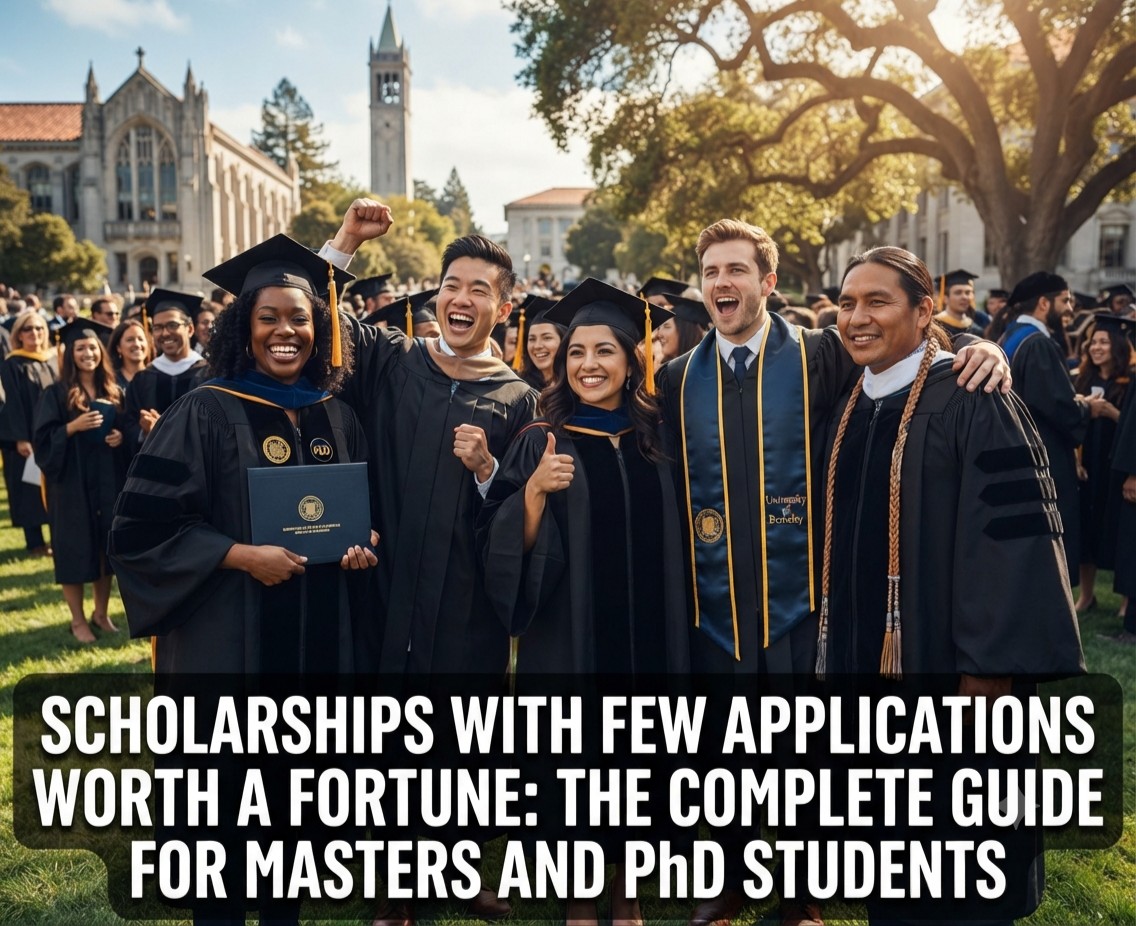
Discover 7 high-value scholarships with few applications worth a fortune. Fully funded Masters and PhD opportunities with official links, deadlines, and application tips to increase your chances.
If you’re chasing a fully funded Masters or PhD but feel like every big scholarship gets 100,000 applications, you’re not alone. Most students apply to the same 5 popular programs and then wonder why it’s so competitive.
However, there is another route. There are scholarships with few applications worth a fortune that fly under the radar. These awards often cover 100% tuition, living stipends, flights, and even research grants. Because they are niche, country-specific, or targeted to underrepresented groups, the applicant pool is much smaller. That means your odds go way up.
In this guide, we’ll break down exactly what these hidden scholarships are, why they get so few applications, and how you can apply for intake. More importantly, we’ll give you direct official links so you don’t waste time.
Let’s dive in.
Why “Low-Competition” Scholarships with few applications worth a fortune Exist
Before we list the scholarships, it’s important to understand the reason behind them.
First, many governments and foundations design scholarships to solve specific problems. For example, climate change in Africa, or public policy in Europe. As a result, they don’t advertise on every major scholarship website.
Second, some scholarships have very specific eligibility. They might target refugees, students with disabilities, or people from a particular region. Because of this, thousands of general applicants can’t qualify, which drops competition.
Third, niche programs often have complex application processes. PDF forms, research proposals, and interviews scare people off. But if you follow the steps, you can stand out easily.
Therefore, if you are strategic, you can apply to awards that pay just as much as Fulbright or Chevening, but with a fraction of the applicants.
7 High-Value Scholarships With Few Applications Worth a Fortune
Below are 7 verified opportunities. Each one is fully funded or high-value, and each one tends to receive far fewer applications than Erasmus or Fulbright.
1. Heinrich Böll Foundation Scholarships in Germany
The Heinrich Böll Foundation Scholarship is one of Europe’s most underrated leadership scholarships. It funds Masters and PhD students in Germany and is open to international students, with a strong focus on applicants from DAC countries.
Why it has fewer applications
Unlike DAAD, this scholarship requires proof of social and political engagement. Many students skip it because they think it’s only for German politics students. In reality, it funds any field.
What it covers
– Financial support for living and academic expenses
– Access to a strong academic and professional network in Germany
– Seminars, workshops, and leadership training
– Integration into a global alumni community.
Who should apply
Students committed to democracy, sustainability, and human rights. You also need strong academics and a clear motivation letter.
Key Deadlines
– Fall intake: 15 July – 1 September Yearly
– Spring intake: 15 January – 1 March Yearly
How to Apply
You must submit official application forms for Masters or PhD. Late applications are not accepted.
Official application and info: https://www.boell.de/en/application
2. Africa Climate Collaborative Scholarships at Makerere University
If you want to study climate, agriculture, or environmental science in Africa, this is a fortune-worth opportunity with very targeted eligibility.
Why it has fewer applications
70% of scholarships are reserved for female applicants, and priority goes to refugees, IDPs, people with disabilities, and youth from minority tribes. Most international students assume they can’t qualify.
What it covers
This is a fully funded postgraduate program through Makerere University’s College of Agricultural and Environmental Sciences. It combines academic excellence with leadership development.
Who should apply
African youth, including international students from African countries. The program specifically promotes African-led solutions to climate change.
How to Apply
Applications are managed through Makerere University. Because it’s new and niche, competition is much lower than global programs.
Official application and info portal: https://caes.mak.ac.ug
3. MEXT Research Scholarsh in Japan for Masters and PhD
The MEXT Scholarship is famous, but the Research Student track for Masters and PhD has far fewer applicants than the undergraduate track.
Why it has fewer applications
Many people think you need to speak Japanese. However, you only need willingness to learn Japanese plus English or Japanese proficiency for research.
What it covers
– 100% tuition waiver
– Monthly stipend: ¥144,000 for Masters, ¥145,000 for Doctoral students
– Round-trip economy airfare
– 6-month Japanese language course if needed
Key Eligibility
– Under 35 years old, born on or after 2 April 1992
– Bachelor’s degree for Masters, Masters-equivalent for PhD
– Must not be military personnel
How to Apply
Applications go through the Japanese Embassy in your country. Deadlines vary by country. Arrival windows are April 2027 or September/October 2027.
Official application and info: https://www.studyinjapan.go.jp/en/smap-stopj-applications-research.html
4. ERP Scholarship Program for US Study
This is a transatlantic program that funds 1-2 year study and research stays at top US universities.
Why it has fewer applications
Only around 10 to 20 scholarships are awarded each year. It’s not widely advertised outside Europe. It targets graduates preparing for roles in public service, policy, NGOs, and research institutions.
What it covers
High-value funding for Master’s degree, research phase, or doctoral courses in the US. The goal is to build bridges between Europe and the US.
Who should apply
Candidates with serious academic records and a clear career direction in public-impact fields.
How to Apply
Announced July 3 yearly. Applications are highly selective but worth it for the US university access.
Official application and info: https://www.studienstiftung.de/en/erp
5. University of Melbourne Graduate Research Scholarships
Australia’s top universities offer hundreds of fully funded research scholarships, yet many students ignore them because they think they need a separate application.
Why it has fewer applications
No separate scholarship application is required. If you apply for admission, you are automatically considered. This means many students miss it simply because they don’t apply to Melbourne.
What it covers
– Full tuition fee waiver
– Living stipend of AUD 39,500 per year
– Relocation allowance
– Overseas Student Health Cover for international students e09f
Who should apply
International and domestic students for Master’s by Research and PhD programmes.
Key Deadline
Application Deadline: 31 October yearly.
Official application and info portal: https://scholarships.unimelb.edu.au
6. Romanian Government Scholarships
This is a classic “hidden gem.” Every year Romania offers 35 scholarships to one country. For 2026/2027, 35 opportunities were offered to Egyptian students.
Why it has fewer applications
It’s country-specific and only announced through diplomatic channels. Most students never hear about it.
Breakdown
– 10 scholarships for bachelor’s level
– 20 scholarships for the master’s level
– 5 scholarships for the PhD level
How to Apply
Applications are sent electronically to the designated email. Deadline is May 15, yearly. Check your country’s embassy for the latest cycle.
Official application and info: https://www.mae.ro/en/node/2176
7. PTDF Overseas Postgraduate Scholarship Scheme
The Petroleum Technology Development Fund from Nigeria funds Masters and PhD abroad, mainly in the UK, Germany, France, and Malaysia.
Why it has fewer applications
It’s only open to Nigerians, and the screening is rigorous. Out of over 38,000 applications, only 5,885 were shortlisted. For PhD, they screened 2,102 applicants last year.
What it covers
Full overseas postgraduate funding. PhD candidates do a split-site arrangement: 1 year abroad and 2 years at PTDF’s research facility in Kaduna.
Who should apply
Nigerian graduates in oil, gas, and related fields. The process follows federal character principle with at least one slot per state.
How to Apply
Monitor the PTDF portal in early 2027. Interviews begin around April.
Official application and info: https://ptdf.gov.ng
How To Find More Scholarships With Few Applications Worth a Fortune
The 7 above are just the start. Here’s how you can find more for yourself:
1. Look for country-specific awards
Governments often fund 20-50 students from one partner country. Check your Ministry of Education website.
2. Target identity-based
scholarships. Awards for women, refugees, people with disabilities, and minorities always have smaller pools.
3. Check university department pages
Not just the main scholarship page. Many professors have research grants that pay stipends but aren’t listed centrally.
4. Use the revolving door strategy.
Programs like ERP fund people who will work in NGOs, policy, or think tanks. If your career goal matches, apply.
In addition, always read the eligibility carefully. If it asks for a research proposal or civic engagement, most students won’t apply. That’s your advantage.
Application Strategy: How To Win Low-Competition Scholarships
Getting the application is only half the battle. To actually win, you need to stand out.
1. Start With The Motivation Letter
For scholarships like Heinrich Böll, your motivation and clarity of goals matter more than grades. Therefore, tell a story. Connect your study to democracy, sustainability, or community impact.
2. Prepare a Strong Research Proposal For PhD
PhD applicants usually need a proposal. Keep it clear, 2-3 pages, and show how it fits the scholarship’s mission. For example, Africa Climate Collaborative wants African-led solutions.
3. Meet The “Hidden” Criteria
Leadership potential and civic responsibility are often more important than a 4.0 GPA. Volunteer work, NGO experience, or community projects count.
4. Apply Early and Follow Instructions
Late applications are not accepted for Böll. Similarly, Romanian applications had a strict May 15 deadline. Set reminders 2 months before.
Common Mistakes To Avoid Applying For Scholarships With Few Applications Worth a Fortune
Even with low competition, you can still lose. Avoid these:
– Applying to everything. Focus on 3-4 scholarships that truly fit your profile instead of 20 random ones.
– Ignoring small scholarships. A $5,000 award with 50 applicants is better odds than a $50,000 award with 50,000 applicants.
– Not contacting your embassy. For MEXT and Romanian scholarships, the embassy is the gatekeeper.
– Weak proof of language. Even if IELTS isn’t required, show you can study in English or Japanese.
Final Thoughts: Your Fortune Is In The Niche
The truth is simple: the biggest scholarships are not always the best scholarships.
Programs like Heinrich Böll, Africa Climate Collaborative, and the ERP US program will fund fewer people, but they will fund them very well. They offer tuition, stipends, travel, networks, and career development.
Moreover, because they are specific, your application won’t get lost in a pile of 100,000. If you are a Masters or PhD student willing to do the work, these scholarships with few applications worth a fortune could change your life.
Start today. Pick 2 from this list, check the official links, and begin your motivation letter. The deadlines for Spring start as early as January.
You’ve got this. Good luck with your application.
SEE ALSO: Norway Mobility. Scholarship 2027 For Masters and PhD Students: Complete Guide + How To Apply
Norway Mobility Scholarship 2027 For Masters and PhD Students: Complete Guide + How To Apply